
Blog
Gas Range Comparison 2026: 21 Models, Dimensions & Buying Guide
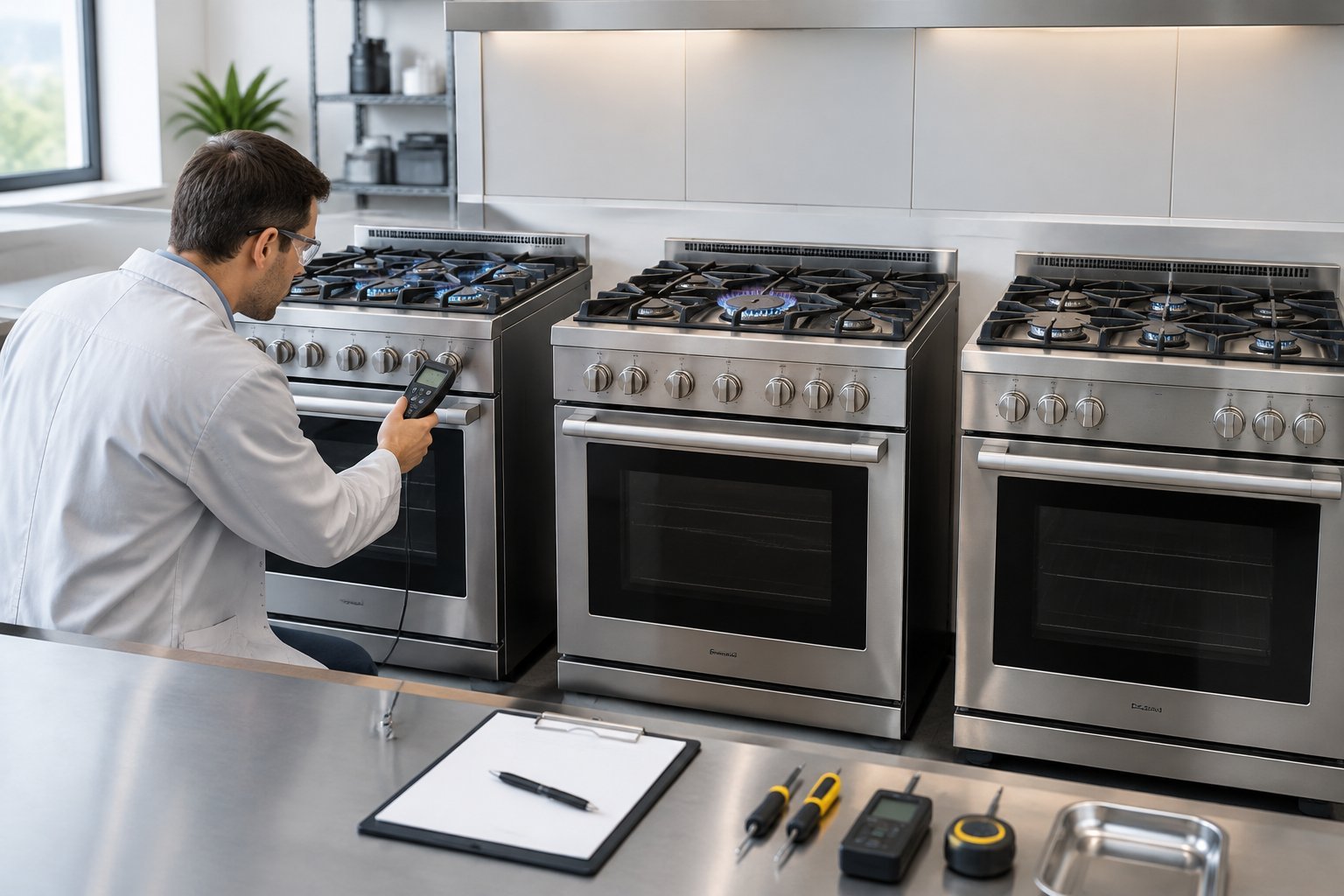
The 21 gas ranges in this benchmark differ by more than brand and price. Each one has an exact model number, a documented set of dimensions, a factory fuel setup, electrical needs, and installation clearances. Together, those details decide whether a range belongs in a specific kitchen. For homeowners, renovators, landlords, and experienced cooks, comparing documented models against real constraints narrows the field faster than a popularity list, and it exposes problems before delivery day.
The catalogue holds 21 exact-model SKUs from 18 model series. Dated US reference prices run from $699 to $7,019. Sixteen of the 21 models carry a nominal 30-inch width, and the median reference price is $1,599. For most US buyers replacing a standard range, the best starting point is a documented 30-inch model in the under-$1,500 band. Seven of the 21 verified models sit there, from $699 to $1,499. Even so, the exact-model installation manual must confirm the fit before purchase.
That second condition carries real weight. Two ranges sold as “30-inch” can differ in actual width, depth with handles, door swing, and electrical needs. A comparison built on manufacturer documents shows those differences early, while there is still time to change the shortlist.
Key Takeaways
- Nominal width is a label, and only exact-model documents confirm whether a range fits.
- The 21-model catalogue leans heavily toward 30-inch ranges priced under $3,000.
- A verified product match still needs installation approval from a qualified professional.
What Does the 21-Model Benchmark Verify?
The benchmark verifies documented product facts for each exact SKU: model number, dimensions and their reference points, fuel setup, electrical requirements, clearances, and a dated reference price. It does not verify cooking performance or fit in any single kitchen. Models whose documents conflict or fall short stay out of the published set.
Manufacturer Documentation, Exact Model Numbers, and Variants
Each published record ties to one exact manufacturer model number. Small differences in a model code can change a finish, a feature set, or a production generation, so a record never borrows data from a “close enough” sibling. Café’s CGS700 series shows why. The catalogue lists three separate SKUs (CGS700P2MS1, CGS700P3MD1, and CGS700P4MW2) at reference prices of $3,099, $3,349, and $3,349. They share a platform, but each finish counts as its own record with its own documents.
That is why the dataset counts 21 SKUs and only 18 model series. Buyers should read the full model code on any quote and match it to the record they researched. Frigidaire shows the risk in practice. The catalogue includes the FCRG3052BS, while third-party dimension listings track a related FCRG3052AS. A one-letter change like that can mean different documents.
Spec sheets cover more than width and height. Knowing how to read appliance specifications that affect real use helps buyers spot when a listing omits a reference point, such as whether depth includes the handle.
Verified Specifications vs. Hands-on Performance Testing
A verified specification confirms what the manufacturer documents. It does not show how evenly an oven bakes or how steadily a burner simmers. Laboratory testing answers those questions, and it frequently upsets price-based assumptions. Consumer Reports, for example, reports that some $1,000 ranges outperform models costing $5,000 in its range tests.
None of the 21 models was put through hands-on testing for this benchmark. Popularity-based lists, including Stove-Gas’s own roundup of the six best gas stoves and ranges of 2026, answer different questions. This benchmark answers a narrower one: what does the paperwork for this exact model say, and does it agree with itself?
Why 38 Unpublished Research Records Are Excluded
The Stove-Gas development catalogue also holds 38 unpublished research records. They were withheld because verification issues remain open: dimensional reference points that conflict between documents, incomplete exact-model evidence, and variants that are discontinued or unavailable. These records are not part of the 21-model benchmark, and no model names, prices, or specs from them appear here.
The cutoff is deliberate. A catalogue of 59 models would look broader. It would also mix confirmed facts with unresolved ones, and buyers could not tell which was which. Holding back records that fail documentation review keeps every published recommendation traceable to source material.
How Do the 21 Published Models Compare?
The 21 models cluster heavily at 30 inches and under $3,000, with thin coverage at the extremes. Six brands appear: Frigidaire (7), Café (4), Cosmo (4), GE (3), GE Profile (2), and LG (1). All reference prices were reviewed on October 20 or October 27, 2026. They are historical figures and do not represent current quotes or stock.
Side-by-Side Model Matrix: Dimensions, Fuel, Electrical Requirements, and Price
Table 1 lists every published SKU. Physical dimensions, fuel setup, and electrical ratings belong to each model’s manufacturer spec sheet and installation manual. Buyers should copy those figures from the exact-model documents and should not rely on the nominal width shown here.
Table 1. All 21 source-reviewed models
| Brand | Model | Nominal width | Reference price | Price band | Price basis |
|---|---|---|---|---|---|
| GE | JGAS640RMSS | 24 in | $1,169 | Under $1,500 | US reference, reviewed Oct 20/27, 2026 |
| GE | JGBS30DEKWW | 30 in | $699 | Under $1,500 | US reference, reviewed Oct 20/27, 2026 |
| GE | JGBS66EEKES | 30 in | $899 | Under $1,500 | US reference, reviewed Oct 20/27, 2026 |
| GE Profile | PGS930YPFS | 30 in | $2,299 | $1,500–$2,999 | US reference, reviewed Oct 20/27, 2026 |
| GE Profile | PGS930BPTS | 30 in | $2,609 | $1,500–$2,999 | US reference, reviewed Oct 20/27, 2026 |
| Café | CGY366P2TS1 | 36 in | $7,019 | $5,000+ | US reference, reviewed Oct 20/27, 2026 |
| Café | CGS700P2MS1 | 30 in | $3,099 | $3,000–$4,999 | US reference, reviewed Oct 20/27, 2026 |
| Café | CGS700P3MD1 | 30 in | $3,349 | $3,000–$4,999 | US reference, reviewed Oct 20/27, 2026 |
| Café | CGS700P4MW2 | 30 in | $3,349 | $3,000–$4,999 | US reference, reviewed Oct 20/27, 2026 |
| Frigidaire | FCRG3052BS | 30 in | $789 | Under $1,500 | US reference, reviewed Oct 20/27, 2026 |
| Frigidaire | FCRG3062AS | 30 in | $849 | Under $1,500 | US reference, reviewed Oct 20/27, 2026 |
| Frigidaire | FCFG3062AS | 30 in | $999 | Under $1,500 | US reference, reviewed Oct 20/27, 2026 |
| Frigidaire | GCFG3060BF | 30 in | $1,499 | Under $1,500 | US reference, reviewed Oct 20/27, 2026 |
| Frigidaire | GCFG3070BF | 30 in | $1,599 | $1,500–$2,999 | US reference, reviewed Oct 20/27, 2026 |
| Frigidaire | PCFG3080AF | 30 in | $1,899 | $1,500–$2,999 | US reference, reviewed Oct 20/27, 2026 |
| Frigidaire | FCRG3083AS | 30 in | $969 | Under $1,500 | US reference, reviewed Oct 20/27, 2026 |
| Cosmo | COS-EPGR244 | 24 in | $1,439.99 | Under $1,500 | US reference, reviewed Oct 20/27, 2026 |
| Cosmo | COS-EPGR304 | 30 in | $1,749.99 | $1,500–$2,999 | US reference, reviewed Oct 20/27, 2026 |
| Cosmo | COS-EPGR366 | 36 in | $2,571.99 | $1,500–$2,999 | US reference, reviewed Oct 20/27, 2026 |
| Cosmo | COS-EPGR486G | 48 in | $3,999.99 | $3,000–$4,999 | US reference, reviewed Oct 20/27, 2026 |
| LG | LSGL5833F | 30 in | $1,599 | $1,500–$2,999 | US reference, reviewed Oct 20/27, 2026 |
Before publication or purchase, each price should be checked again against current manufacturer and retailer pages. Any change in availability or discontinuation should be stated openly, and the historical figure should never be quietly replaced.
What the 21-Model Gas Range Benchmark Reveals
24-Inch and 30-Inch Gas Ranges: Compact Design Versus Mainstream Choice
The Stove-Gas 2026 verification benchmark demonstrates how appliance dimensions, price and installation requirements vary across different product categories. The two reviewed 24-inch models serve consumers researching compact kitchen installations, including the GE JGAS640RMSS, with a historical reference price of $1,169. However, a nominal 24-inch designation does not establish compatibility with every 24-inch kitchen opening. The 30-inch category represents the largest portion of the benchmark, accounting for 16 of the 21 reviewed models. Three representative examples illustrate the diversity of this segment: the Frigidaire FCRG3052BS, with a $789 reference price and 28.5-inch listed depth; the LG LSGL5833F, priced at $1,599 with a 29.21875-inch listed depth; and the GE Profile PGS930YPFS, priced at $2,299 with a 29.5-inch listed depth. These figures illustrate differences in manufacturer-reported dimensions and pricing, although the precise depth measurement reference points must be checked before making direct installation comparisons. A consumer comparing these appliances should evaluate the exact model’s specifications, installation instructions, electrical requirements and fuel configuration rather than relying exclusively on nominal width or price.
36-Inch and 48-Inch Gas Ranges: Premium Equipment and Installation Complexity
Larger residential gas ranges introduce additional considerations involving kitchen geometry, electrical connections, ventilation and manufacturer-specific installation conditions. The benchmark includes two 36-inch models, including the Café CGY366P2TS1, which has a manufacturer-listed width of 35.875 inches, a listed depth of 31.125 inches and a historical reference price of $7,019. The single reviewed 48-inch appliance, the Cosmo COS-EPGR486G, has a listed width of 47.9375 inches, a listed depth of 27.875 inches and a reference price of $3,999.99. These examples demonstrate that a larger nominal appliance is not necessarily more expensive than every smaller premium model, nor does nominal width determine overall installation complexity. Buyers must consider documented dimension reference points, door and handle projection, electrical specifications, gas connections, ventilation conditions and applicable clearances. The Stove-Gas Finder’s compatibility approach is designed to identify relevant product constraints and outstanding professional checks rather than assume that an appliance is suitable simply because its advertised width matches the available kitchen space.
Research Methodology, Manufacturer Documentation and Benchmark Limitations
This original Stove-Gas benchmark comprises 21 reviewed exact-model SKUs across six brand labels: GE, GE Profile, Café, Frigidaire, Cosmo and LG, covering 24-, 30-, 36- and 48-inch categories. Its historical reference prices range from $699 to $7,019, based on manufacturer or retailer information reviewed on October 20 or October 27, 2026, depending on the model. The research uses exact-model technical specifications, manufacturer installation documentation and dated reference-price evidence rather than independent laboratory performance testing. An additional 38 research records remain unpublished because of unresolved verification issues. The dataset is a deliberately selected, source-reviewed catalogue, not a statistically representative assessment of the entire US gas-range market. Reference prices do not guarantee current availability, delivery costs or installation-inclusive quotations. Manufacturer documentation must be rechecked before purchase, and final installation suitability requires qualified professional verification. This evidence-based approach underpins the developed Stove-Gas Finder V2, which combines product constraints, explainable recommendations and anonymous downloadable buyer reports to help consumers make more informed purchasing decisions.
Comparing 24-, 30-, 36-, and 48-Inch Ranges
Width coverage follows the shape of the US market. It is still a curated set and does not represent that market statistically.
Table 2. Width-category distribution and buyer implications
| Nominal width | Models | Share | Reference price span | What the coverage means for buyers |
|---|---|---|---|---|
| 24 in | 2 | 9.5% | $1,169–$1,439.99 | Usable starting set for small kitchens; limited comparison depth |
| 30 in | 16 | 76.2% | $699–$3,349 | Broadest choice across three price bands |
| 36 in | 2 | 9.5% | $2,571.99–$7,019 | Two very different price points; little middle ground |
| 48 in | 1 | 4.8% | $3,999.99 | Single documented option; a no-match result is likely for specific needs |
The 30-inch group has a median reference price of $1,599, which equals the median for the full catalogue. All six models priced under $1,000 are 30-inch ranges. Buyers who need 36 or 48 inches face a much thinner documented field. A shopper looking for a 48-inch range under $3,000 will find nothing here, and the catalogue is built to say so plainly.
Documented Differences, Conditional Requirements, and Unresolved Questions
Records within one width group still differ in ways that change installation. Independent dimension listings drawn from manufacturer spec sheets put the Café CGS700P3MD1 at an overall width of 29 7/8 inches as a gas slide-in. A freestanding 30-inch model may document a different width and a different relationship to the countertop.
Conditional requirements are where many purchases go wrong. Manuals often state clearances that apply only under certain conditions, such as an unprotected combustible wall beside the range or a specific hood type above it. A requirement that holds “when installed next to a side wall” does not mean zero clearance elsewhere. When a manual is silent on a measurement, that silence remains an open question until the manufacturer or installer answers it.
Which Dimensions Determine Whether a Range Fits?
Fit depends on actual width, depth with handles, height range, door swing, and the cutout the manufacturer specifies. The nominal size only sorts products into a category. Configuration (freestanding or slide-in) then changes how those numbers meet the cabinets and countertop.
Nominal Width vs. Actual Dimensions and Required Openings
A “30-inch” range is a size class. Industry guidance cites actual body widths of 29.875 to 30.125 inches, with a recommended cabinet cutout of 30.125 inches for that class. A model at the upper end of that span needs a precise opening, and old cabinets that have shifted over time may no longer measure true.
Table 4. Nominal width vs. documented dimensional reference points
| Measurement | Why it matters | Verified example in this benchmark | What buyers must confirm |
|---|---|---|---|
| Overall width | Must clear the cabinet opening | Café CGS700P3MD1: 29 7/8 in (manufacturer spec sheet) | Exact figure for each other SKU |
| Required cutout | Manufacturer’s minimum opening | Not stated here for any SKU | Installation manual cutout figure |
| Depth without handle | Body alignment with counter | Not stated here | Spec sheet body depth |
| Depth with handle | Walkway and island spacing | Not stated here | Handle projection in spec sheet |
| Door-open depth | Space needed in front of the range | Not stated here | Door-open dimension and hinge geometry |
| Height range | Leveling to counter height | Not stated here | Adjustable leg span and its reference point |
| Reference point | Where each measurement starts | Varies by manufacturer | Whether depth is taken from the wall, the back panel, or the cabinet face |
Only one row in Table 4 has a figure, and that is intentional. The benchmark does not publish measurements it cannot trace to a manufacturer document.
Depth, Handles, Door Swing, and Adjustable Height
Depth is the measurement buyers most often get wrong. A spec sheet may list body depth, depth with the handle, and depth with the door open as three separate numbers. In a galley kitchen or across from an island, the door-open figure decides whether someone can stand in front of the oven. Different manufacturers also measure depth from different points (the rear wall, the back of the cooktop, or the front of the cabinets), so the same “27 inches” can describe two different situations.
Height leveling has limits as well. Adjustable legs let a range meet a standard 36-inch counter, but each model’s manual sets the minimum and maximum height and states whether those numbers include the cooktop grates.
Freestanding vs. Slide-in Configurations and Cabinet Clearances
Freestanding ranges have finished sides and a rear control panel or backguard, and they sit between cabinets. Slide-in ranges have front controls and are built to meet or overlap the countertop, so the counter cut matters. Fit guidance points out that a slide-in’s countertop cut should be confirmed before counters are templated.
Swapping configurations is rarely a simple drop-in. A slide-in moved into a space built for a freestanding unit may leave a gap at the back or require counter work. A freestanding unit placed in a slide-in opening may stand proud of the cabinet line. Manufacturer clearances to side walls and overhead cabinets apply in both cases.
Will the Fuel and Electrical Requirements Match Your Kitchen?
A range matches a kitchen only when its documented fuel setup and electrical needs line up with the supply already in place, or with planned upgrades. Factory fuel, conversion permission, and voltage are three separate checks, and none of them follows automatically from the others.
Factory Natural Gas Configuration and Documented Propane Conversion
Most residential gas ranges ship set up for natural gas. Professional-range sellers warn buyers on propane to check that the model comes with an LP conversion kit included, because buying one later adds cost. Inclusion varies by model, and permission matters as well. A conversion counts as documented only when the manufacturer names the kit or procedure for that exact SKU and requires a qualified installer to perform it.
The benchmark does not assume a model can be converted to LPG. Homes on propane should treat conversion as a hard requirement and confirm it in the exact-model manual before shortlisting.
All-Gas vs. Dual-Fuel Electrical Requirements
All-gas ranges still use electricity for igniters, lights, clocks, and electronic controls. For gas ranges, home inspection guidance calls for a 120-volt receptacle at or near the appliance to power those parts. Dual-fuel ranges, which pair gas burners with an electric oven, are a different case. One range seller notes that dual-fuel models require a 240V dedicated circuit in addition to the gas line.
This difference can add an electrician’s visit and a new circuit to the project. Buyers who like dual-fuel ovens for baking, a topic covered in the guide to electric ovens for holiday baking and roasting, should budget for that wiring. The catalogue treats electrical setups as non-interchangeable and records each model’s stated requirement.
Supply Connections and Installation Conditions Requiring Professional Confirmation
Gas connection details fall under local code. Inspection guidance places the manual shutoff valve in the kitchen within 6 feet of the appliance, and it limits connector length to 6 feet. Codes also require ranges to be listed and labeled by a recognized testing laboratory and installed per the manufacturer’s instructions, and cities such as New York and San Francisco add local amendments.
Several items need a licensed professional to confirm them:
- Gas line diameter and pressure for higher-output cooktops.
- Shutoff valve location and whether a sediment trap is required.
- Receptacle type, circuit rating, and placement behind the unit.
- Local permits and any fossil-fuel equipment restrictions.
What Does Each Price Tier Offer?
Each tier in the benchmark offers a different mix of width and configuration choices, and a higher price does not guarantee better cooking results. The price bands here reflect dated reference prices only.
Table 3. Reference-price distribution across four budget bands
| Price band | Models | Share | Widths represented | Brands represented |
|---|---|---|---|---|
| Under $1,500 | 9 | 42.9% | 24 in (2), 30 in (7) | GE, Frigidaire, Cosmo |
| $1,500–$2,999 | 7 | 33.3% | 30 in (6), 36 in (1) | GE Profile, Frigidaire, Cosmo, LG |
| $3,000–$4,999 | 4 | 19.0% | 30 in (3), 48 in (1) | Café, Cosmo |
| $5,000 and above | 1 | 4.8% | 36 in (1) | Café |
Under $1,500: Comparing Essential Specifications
Nine models fall into this band, the largest. It includes both 24-inch models (GE JGAS640RMSS at $1,169 and Cosmo COS-EPGR244 at $1,439.99) and seven 30-inch models from $699 to $1,499. For a straight replacement in a standard 30-inch opening, this band offers the most documented options to compare. Buyers here should focus on actual width, depth with handles, and LPG conversion before features. Brand positioning in this segment is discussed further in the look at getting Samsung, LG, and GE models for less.
$1,500–$2,999: Evaluating Additional Features
Seven models sit in the middle band, including the GE Profile PGS930 pair, Frigidaire GCFG3070BF and PCFG3080AF, LG LSGL5833F, and two Cosmo models. The Cosmo COS-EPGR366 at $2,571.99 is the only 36-inch range priced under $3,000 in the catalogue. Buyers should check that each extra feature in this band matches how they cook, and that any front-control or slide-in design suits their counters.
$3,000–$4,999: Assessing Premium Features and Configuration
Four models land here: three Café CGS700 finish variants and the Cosmo COS-EPGR486G, the only 48-inch range in the set. The Café variants differ by finish and SKU, so a quote must name the exact one. A 48-inch purchase adds hood, cabinet, and gas-supply questions that can outweigh the appliance price difference.
$5,000 and Above: Examining Professional-Style Residential Options
One model fills this tier: the Café CGY366P2TS1, a 36-inch range at $7,019. Professional-style ranges can bring higher burner output, which raises the ventilation and gas-supply needs that installers must confirm. A $7,019 reference price does not establish better cooking than lower tiers, since independent laboratories regularly find mid-priced ranges matching costlier ones.
Dated Reference Prices vs. Total Installed Cost
Reference prices leave out delivery, haul-away, connectors, conversion labor, electrical work, cabinet or counter changes, permits, and hood upgrades. A $1,749.99 range that needs a new circuit and a counter recut can cost more installed than a $2,299 model that drops into place. The retailer channel also changes the final figure. Comparing big-box stores and discount appliance retailers helps buyers price delivery and installation terms alongside the appliance, and open-box appliances bring warranty and condition checks of their own.
Which Cooking Features Matter Beyond the Specification Sheet?
Features on a spec sheet describe hardware. How that hardware cooks depends on burner spacing, low-end control, and usable oven space, and those aspects rarely show up as a single number. The benchmark records features as the manufacturer documents them and does not grade cooking results.
Burner Output, Simmer Claims, and Cookware Spacing
Peak BTU ratings attract attention, but the low end matters for sauces and melting. A burner that sears well may still scorch chocolate if it cannot turn down far enough. Burner layout also affects daily use. Two large pots on a 30-inch cooktop may not fit side by side if the high-output burners sit next to each other. Buyers should compare grate layout diagrams in the spec sheet along with the BTU list.
Oven Capacity, Convection, and Multiple-Oven Layouts
Listed oven capacity in cubic feet can include space below the lowest rack that cannot hold food, and some independent testers measure usable capacity for that reason. Convection systems differ as well. A fan alone circulates heat, while “true” or third-element convection adds a dedicated heat source. Double-oven layouts trade one large cavity for two smaller ones, which suits cooks who bake and roast at different temperatures.
Griddles, Cleaning Systems, Controls, and Smart Features
Integrated griddles, self-clean or steam-clean cycles, front or rear controls, and Wi-Fi connectivity all appear across the market. Each one carries trade-offs. Self-clean cycles run at high heat, steam-clean handles lighter soil, and front controls change how a slide-in sits against the counter. Smart features depend on app support over time. Buyers should rank these features after fit, fuel, and electrical needs are settled.
How Should Reliability and Ownership Costs Influence the Comparison?
Ownership costs should shape the shortlist through checkable facts: written warranty terms, local service coverage, and parts availability. Broad brand reliability reputations carry far less weight. The benchmark does not rank brands for reliability.
Warranty Terms, Local Service Coverage, and Parts Availability
Warranty length and coverage differ by manufacturer and sometimes by model line. Buyers should read the written terms for the exact SKU and check whether parts and labor are both covered. A warranty helps only when an authorized technician serves the buyer’s area. Landlords managing several units should ask about parts lead times, since a range waiting weeks for an igniter means a tenant without a stove.
Cleaning, Maintenance, and Repairability
Sealed burners, removable grates, and accessible igniters make routine care simpler. Repairability depends on how easily a technician can reach the controls, valves, and sensors, and on whether the manufacturer supplies parts for years after launch. When a range breaks, the decision to repair, replace, or buy used turns on parts cost, labor, and safety, and those factors begin with the model chosen today.
Operating-Cost Estimates and the Limits of Brand Reliability Claims
Operating costs for a gas range depend on local gas and electric rates, cooking habits, and whether the oven runs on gas or electricity. Any annual estimate is a projection and not a measured figure. Brand reliability claims come from surveys of past models, and design changes can make them a weak guide for a current SKU. Treat them as one input among many, and give more weight to documented warranty terms and local service access.
What Safety and Ventilation Checks Remain Before Purchase?
Ventilation, anti-tip protection, and qualified installation must all be confirmed for the specific kitchen before any range is ordered. A documented model match covers none of these on its own.
Range Hood Venting and Manufacturer Clearance Requirements
Gas cooking releases combustion byproducts indoors, so a working hood that vents outside is the strongest everyday control. Practical steps for households concerned about indoor air appear in what to do if you’re worried about your gas stove. Model codes commonly require 30 inches of vertical clearance above the cooktop to unprotected combustible material, with exceptions for certain listed hoods and microwaves.
Hood sizing should follow the exact range and duct route. Planning checklists caution buyers not to select a hood from range width alone. Makeup-air rules in some jurisdictions also apply to high-airflow hoods.
Anti-Tip Protection and Qualified Installation
Inspection checklists list a missing anti-tip device as a major defect, because a range can tip forward when weight rests on an open door. The bracket must be installed and engaged per the manufacturer’s instructions for that exact model. Child safety around cooking appliances belongs on any list of home safety essentials for 2026. A qualified installer should also leak-test gas connections and confirm the range sits level and stable.
Why a Verified Product Match Is Not Installation Approval
A verified match means a model’s documents fit the buyer’s stated budget, width, fuel, and configuration. Installation approval is a separate step: a qualified professional inspects the actual kitchen, supply lines, walls, and hood against the manual and local code. The first step narrows choices. Only the second confirms the range can go in safely.
Table 5. Product filters vs. documented kitchen compatibility
| Question | Price/width/brand filter answers it? | Exact-model documents answer it? | Still needs on-site confirmation? |
|---|---|---|---|
| Is it within budget? | Yes (reference price only) | Not applicable | Installed cost, yes |
| Is it the right size class? | Yes | Yes | Opening measurements, yes |
| Does actual width fit the opening? | No | Yes | Yes |
| Does depth with handle suit the walkway? | No | Yes, if documented | Yes |
| Is LPG conversion permitted? | No | Yes, if documented | Installer performs it |
| Does the electrical setup match? | No | Yes | Electrician verifies circuit |
| Are side and overhead clearances met? | No | Conditional | Yes |
| Is the gas supply adequate? | No | Partial (input ratings) | Yes |
| Is the installation code-compliant? | No | No | Yes |
How Can You Turn the Comparison Into a Suitable Shortlist?
A suitable shortlist comes from applying budget, dimensions, fuel, and configuration as hard limits at the same time, then recording what stays uncertain. Stove-Gas built its Finder V2 around this approach, using the same 21-model catalogue.
Matching Budget, Dimensions, Fuel, and Configuration Together
Single filters fail when used one at a time. A shopper who filters by “30-inch” and “under $1,500” gets seven models but still does not know which ones convert to propane or fit a slide-in counter cut. Applying all four limits together removes unsuitable models early. Planning the wider room, as in the guide to making a kitchen functional and efficient, helps define those limits before the search starts.
The Stove-Gas Finder V2 collects requirements through a guided three-step process and treats budget and compatibility as hard limits. It evaluates only verified models and does not pad results with popular ones.
Understanding Match Explanations, Unknowns, and No-Match Results
A useful match explains itself: why the model fits, which specs are relevant, which requirements remain unknown, and which installation conditions need a professional. The Finder is designed to show these points with each result.
A no-match result is useful information. If a buyer needs a 48-inch propane range under $3,000, the catalogue cannot meet it, and an honest “no match” prevents a costly near-miss. The buyer can then change one limit (budget, width, or fuel), widen the search to unverified models with extra caution, or ask a retailer for exact-model documents to review.
Preparing an Anonymous Buyer Report for Retailer and Installer Discussions
The Finder V2 can produce a local buyer report that lists matched models, comparison details, questions to ask, and installation points. Reports can be printed, downloaded, or copied. Answers are processed on the buyer’s own device and are not sent to any retailer automatically. Optional analytics are off, and no lead collection or CRM link exists.
For retailers, a documented framework like this can give sales conversations more structure. A customer arriving with a report has already named the exact SKU, the open questions, and the installer checks, so staff can confirm facts in place of restarting discovery. The plugin includes configurable operator details and retailer handoff links. Any commercial benefit, such as fewer returns or higher conversion, has not been measured and remains to be shown with real retailer users.
On status: the latest development version is 0.3.0. It has passed 65 automated tests, along with isolated WordPress staging, editor, mobile, and catalogue backup and rollback checks. Those results do not confirm deployment on the live Stove-Gas.com site. Private staging on the production theme remains a separate step before public release, and no retailer partnership exists unless formally authorized.
Choose a Documented Match, Then Confirm the Installation
The 21-model benchmark shows that a reliable gas range comparison begins with exact model numbers and manufacturer documents. Rankings and nominal widths come second. Sixteen of the 21 models are 30-inch ranges, seven of those sit under $1,500, and the catalogue offers just one 48-inch option and one model above $5,000. Those gaps tell buyers where documented choice is broad and where it runs out.
A practical sequence works best. Measure the opening, then confirm fuel type and receptacle. Set a budget that covers installation costs. Shortlist two or three exact SKUs whose documents fit those limits, and write down every unknown. Bring that list to the retailer and a qualified installer, check current prices and availability, and order only after the installer confirms clearances, gas supply, electrical service, ventilation, and anti-tip mounting for the chosen model.
A useful gas range comparison 2026 should help homeowners identify which models genuinely fit their kitchens, cooking requirements and budgets. Our 21-model comparison examines gas ranges from GE, GE Profile, Café, Frigidaire, Cosmo and LG, emphasizing documented specifications rather than promotional rankings. One of the most important buying considerations is the difference between nominal appliance size and actual dimensions. For example, the GE JGAS640RMSS has a documented width of 24 inches and depth of 28.125 inches, while the GE JGBS30DEKWW measures 30 inches wide and 28.75 inches deep. Buyers should also examine oven capacity, burner output measured in British thermal units (BTU), cooking features, door clearance and ventilation requirements. These specifications must be confirmed against the exact manufacturer’s model documentation rather than assumed from the appliance’s nominal width.
Selecting the right gas range requires more than comparing prices or choosing the appliance with the highest advertised BTU output. A powerful burner may suit high-heat cooking, while effective low-temperature control, practical oven capacity and dependable temperature regulation can be equally important for everyday meals. Homeowners should evaluate whether they need convection cooking, air-frying functionality, a griddle, self-cleaning features or a particular oven configuration. Installation considerations are equally important: natural gas and propane compatibility, electrical supply, anti-tip protection, cabinet clearances and kitchen ventilation must be assessed before purchase. A practical gas range buying guide should therefore help readers compare actual appliance dimensions, independently documented features, manufacturer installation instructions and total ownership costs. An affordable model that fits the kitchen correctly may offer greater practical value than a more expensive appliance requiring substantial modifications.
Our 21-model verification approach prioritizes manufacturer specifications, documented appliance dimensions, installation requirements and dated pricing evidence. This distinction matters because a manufacturer’s published specification is not the same as independent hands-on testing, and product availability or prices can change. Buyers should use the comparison to create a shortlist, then consult the exact manufacturer’s specification sheet for burner BTU ratings, oven capacity, fuel compatibility, warranty coverage and installation requirements. Where a specification has not been independently confirmed, it should be treated as unverified rather than estimated. The strongest purchasing decision combines reliable technical information with practical household needs: the right dimensions, appropriate cooking performance, safe installation, manageable operating costs and dependable after-sales service. This evidence-based approach makes comparing 21 gas range models more useful than relying on popularity rankings or unsupported claims about which appliance is best.
Frequently Asked Questions
Were all 21 gas ranges independently tested?
No. The 21 models were verified against manufacturer documents for model numbers, dimensions, fuel, electrical needs, clearances, and dated prices. Cooking performance and durability were not tested in a lab for this benchmark.
Does this comparison identify the best gas range for every kitchen?
No single model suits every kitchen, and the benchmark does not name a universal winner. It identifies which documented models match a given budget, size, fuel, and configuration. Installation still needs on-site confirmation.
Which verified models are freestanding gas ranges?
Configuration is recorded for each model from its manufacturer documents, and buyers should confirm it in the exact-model spec sheet before ordering. Café’s CGS700P3MD1, for example, is documented as a gas slide-in. Model-code patterns can hint at configuration but do not prove it.
Are professional-style residential ranges suitable for a standard home kitchen?
Many can be installed in homes, though they often need more ventilation, larger gas supply, and wider clearances. The Café CGY366P2TS1 at $7,019 is the catalogue’s only model above $5,000. A qualified installer should confirm hood capacity, gas line sizing, and wall clearances first.
Can this benchmark identify the most reliable gas range brand?
No. The benchmark does not rank brands for reliability, because survey-based ratings describe past models and may not apply to current SKUs. Buyers get more useful guidance from written warranty terms, local service coverage, and parts availability for the exact model.
What should I do if none of the 21 models meets my requirements?
Treat the no-match result as useful guidance. Relax one limit, such as budget, width, or fuel, and run the comparison again. Alternatively, request exact-model manuals for other ranges and check them against the same dimensional, fuel, and electrical criteria before buying.